A framework for lasting change
The 3R Method™
Reflect. Rectify. Redesign.
The working framework Debbie uses inside orthodontic and dental practices to create change that actually holds.
Most practices don't struggle because the people are wrong. They struggle because good people are doing their best inside systems no one ever sat down and designed on purpose.
When something starts to slip, the usual response is another meeting, another course, a new piece of software, or a temporary fix to get through the week. None of that is wrong on its own. It just rarely changes anything for long, because it isn't aimed at the real problem.
After more than two decades inside orthodontic and dental practices, Debbie built the 3R Method as a way to work through change in a way that actually sticks.
Consulting, courses, leadership work, TC development, digital workflow, insurance. Whatever the engagement, it moves through the same three phases: Reflect, Rectify, Redesign.
Why this method exists
Every practice wants the same things. Stronger treatment acceptance. A team that communicates well. Cleaner workflows. A patient experience the doctor is proud of. Consistency that doesn't fall apart on a busy Tuesday.
The problem is that most practices try to solve those things before they've really understood what's getting in the way.
The 3R Method is built to slow that down. We look first, fix what's actually broken, and then put structure around it so the improvements don't quietly disappear three months later.
The framework
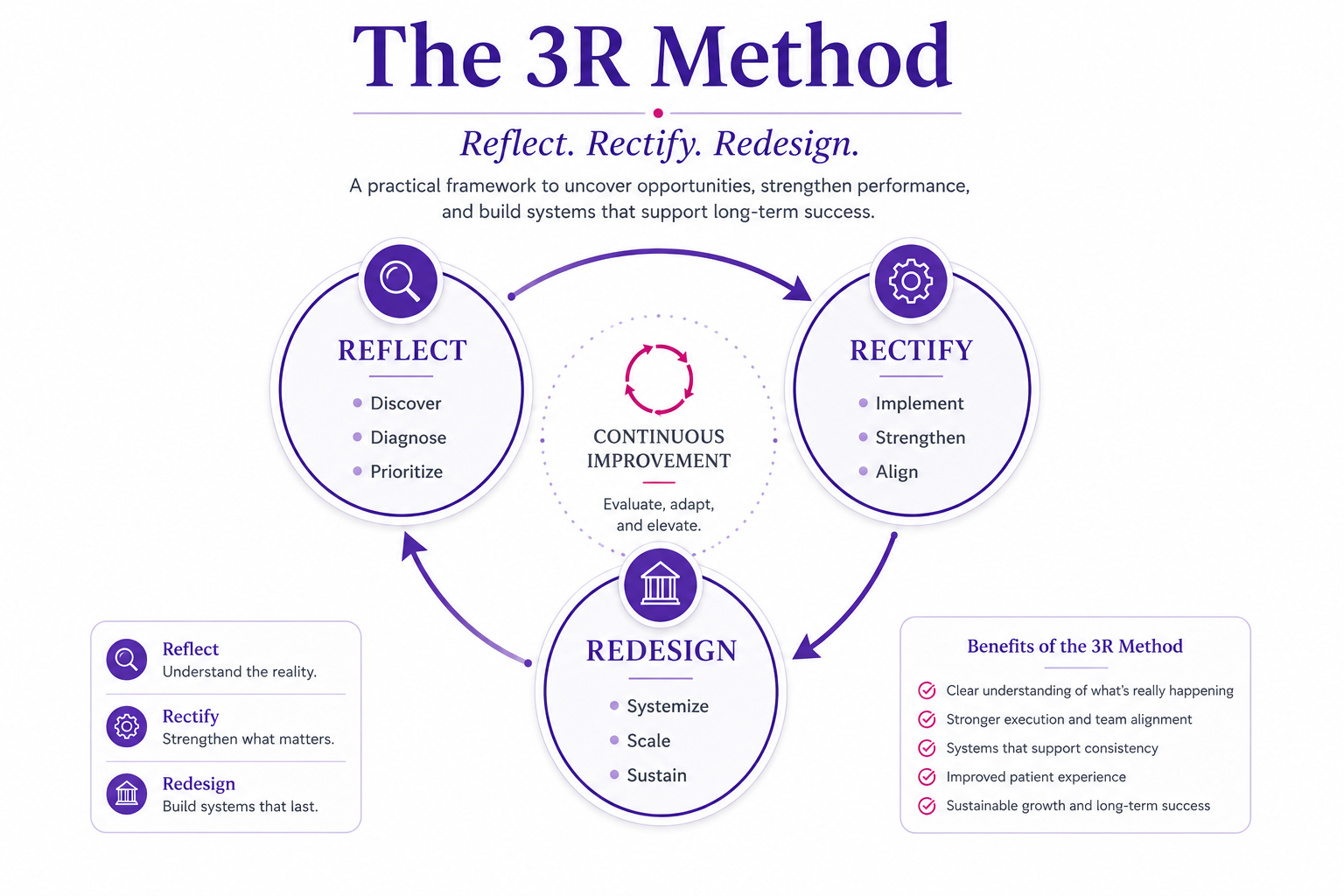
A cycle the practice keeps coming back to, not a one-time fix.
01Phase 01
Reflect
See what's actually happening before trying to fix it.
Most practices think they know where the friction is. Often, the real issue sits somewhere else. Reflect is the part of the work where we slow down, watch the practice run, and look at the day honestly. Consults, handoffs, conversations at the front desk, the small things that quietly cost time and treatment starts.
Things we tend to look at during Reflect:
- New patient flow, from first call to consult
- How the Treatment Coordinator actually presents and follows up
- How the team talks to each other during the day
- Where leadership is helping, and where it's getting in the way
- The patient experience, start to finish
- How well the practice is using its software
- Insurance verification, presentation, and follow-through
- Who owns what, and how that's tracked
- The everyday operations no one has questioned in years
What changes after Reflect
- A clear, honest picture of how the practice runs today
- The gaps no one had named out loud
- Better alignment between the doctor, leadership, and team
- A short list of priorities that actually matter
- Less guessing about where to start
This isn't about pointing fingers. It's about getting an honest read on the practice so the next steps are based on what's real, not what's assumed.
02Phase 02
Rectify
Fix what's slowing the practice down.
Once we know what's really happening, we get to work. Rectify is the hands-on phase: coaching the TC chairside, sitting in on consults, cleaning up workflows that have drifted, and tightening the handoffs that have been costing the practice patients and time.
This is where new habits replace old ones.
Where training stops being a slide deck and starts showing up in the chair.
Where the team begins to feel the difference, week to week.
Depending on the practice, Rectify often includes:
- Coaching the team in real situations, not just in meetings
- Cleaning up workflows that have quietly drifted
- Working with the doctor and managers on how they lead the day
- Tightening how the team communicates around the patient
- Treatment Coordinator development and consult conversion
- Getting more out of the software the practice already pays for
- Improving the patient experience at the moments that matter
- Insurance presentation, verification, and follow-up
- Putting real ownership behind tasks and outcomes
What changes after Rectify
- A team that knows what's expected and can deliver it
- Consults that convert more consistently
- Communication that doesn't fall apart on a busy day
- Cleaner handoffs and fewer dropped balls
- More finished cases, less wasted time
- Patients who notice the difference
03Phase 03
Redesign
Build it so it lasts after we leave.
Improvements rarely stick when they live in one person's head. The minute that person is off, the system goes with them. Redesign is where we turn the changes from Rectify into something the practice can actually run on its own.
We sit down with the doctor and leadership and design the next version of the practice on purpose. Workflows, accountability, how new team members are brought up to speed, how the practice plans for growth. The goal is something durable, not a temporary lift.
When this phase is done well, the practice keeps moving forward long after the engagement ends.
What we usually build in this phase:
- Workflows written for this practice, not borrowed from somewhere else
- A leadership rhythm the doctor and managers can actually keep
- Clear ownership and accountability that doesn't depend on one person
- A patient journey designed end to end
- Onboarding and development paths for new and existing team members
- Communication frameworks that hold up on a packed day
- A realistic plan for growth
- Standards the team can be held to fairly
What changes after Redesign
- Systems that survive turnover and busy seasons
- Consistency that doesn't depend on one strong person
- A practice that can grow without breaking
- Doctor and leadership pulling in the same direction
- A patient experience that holds up every day, not just on good ones
- Continued progress after Debbie is no longer in the building
In practice
How this shows up in consulting
Every consulting engagement follows the same path. We start by understanding the practice as it really is. We name the things worth fixing. We coach the team through the changes, in the chair and at the front desk. Then we build structure around what's working so it lasts.
You don't end up with a binder of recommendations. You end up with a practice that runs differently.
In practice
How this shows up in continuing education
A great course doesn't change a practice on its own. Our CE is built around the same three phases the consulting work follows, so the learning actually translates back to the office.
Reflect FoundationsUnderstand what's actually happening in the practice before changing anything.
Rectify CoreBuild the skills and habits that move the needle in real consults and real days.
Redesign AcceleratedTurn what's working into systems the team can run without you in the room.
The point is simple. People leave with something they can use on Monday morning, not just a certificate.
Explore CEWho it's for
The people this work is built for
The 3R Method is used with doctors, leaders, and full teams across orthodontic and dental practices in Canada and beyond:
- Orthodontists
- General Dentists
- Treatment Coordinators
- Office Managers
- Front Office Teams
- Dental Assistants
- Hygienists
- Practice Leaders
- Growing Practices
If you want stronger consults, a calmer team, cleaner workflows, or leadership that actually leads, this is the work.
Real change happens on purpose.
A practice doesn't change because the team sat through a course. It doesn't change because a consultant was in the building for a few days. It doesn't change because new software was installed.
It changes when people see the practice clearly, fix what's actually getting in the way, and put real structure around what's working.
That's what this method is for.
Reflect. Rectify. Redesign.
A simple framework for moving a practice from intention to implementation, and from implementation to something that lasts.
Want to talk about your practice?
Have a look at the consulting work, browse the CE programs, or book a call and tell Debbie what's going on in your office.